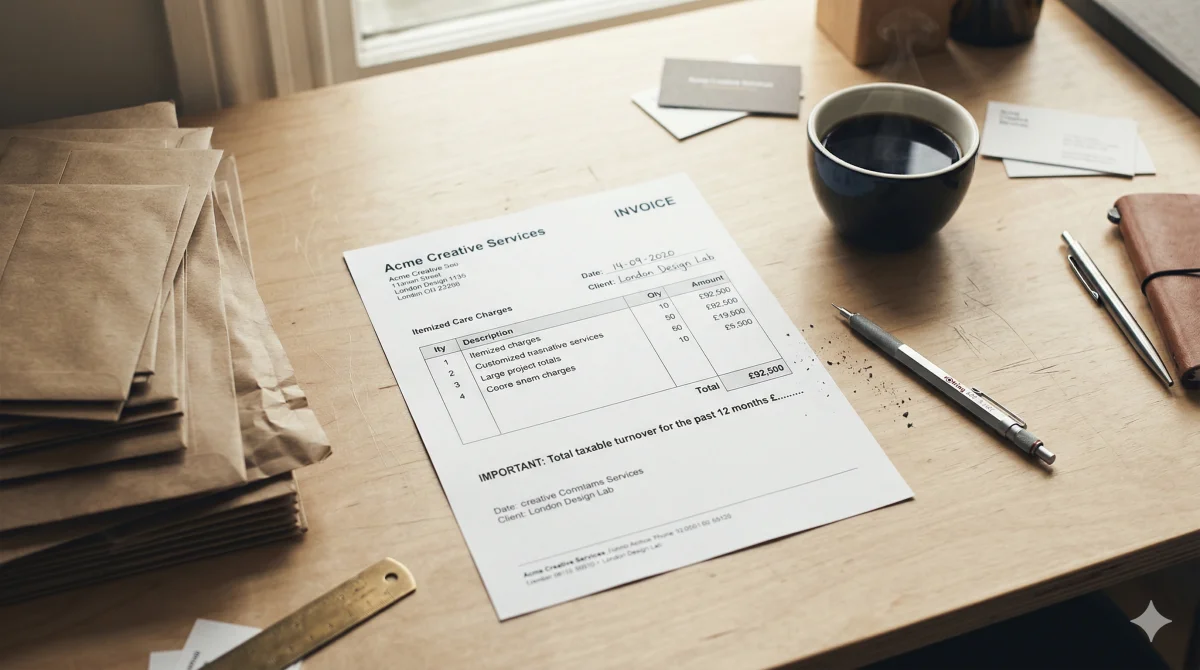
The VAT registration threshold hasn't moved. It's still £90,000 for the 2026/27 tax year, exactly where it's been since April 2024. And while the government keeps it frozen, inflation keeps pushing businesses closer to that line whether they like it or not.
If you're a sole trader, freelancer, or small business owner whose turnover is creeping up, you need to know the rules — and whether registering early might actually work in your favour.
When you MUST register
This is the non-negotiable bit. You're legally required to register for VAT if either of these apply:
- Your taxable turnover exceeds £90,000 in any rolling 12-month period. Not your financial year. Not the tax year. Any consecutive 12-month window. HMRC can look backwards at any point and check.
- You expect your taxable turnover to exceed £90,000 in the next 30 days alone. Land a big contract? Win a sudden windfall of work? You might need to register before you've actually invoiced a penny of it.
That rolling 12-month rule catches people out constantly. You can't just check your turnover in January and forget about it. If your revenue for, say, July 2025 to June 2026 crosses £90,000, you should've registered by the end of July 2026 at the latest. Miss it and HMRC will backdate your registration — and you'll owe VAT you never charged your customers.
A practical habit: check your rolling turnover monthly once you're above £70,000. It's five minutes with a spreadsheet. Don't leave it to your annual accounts.
When voluntary registration makes sense
Here's the part most people don't realise: you can register for VAT at any level of turnover. There's no minimum. You could be earning £10,000 a year and register voluntarily if you wanted to.
Why would you?
You sell to other VAT-registered businesses. If your customers are VAT-registered, they can reclaim the VAT you charge them. It costs them nothing. Meanwhile, you get to reclaim VAT on everything you buy — software subscriptions, equipment, professional services, fuel. For B2B businesses with significant expenses, voluntary registration can put real money back in your pocket.
You're buying a lot of equipment or stock upfront. Starting a business that needs expensive kit? Fitting out a workshop or office? Registering for VAT before you start trading lets you reclaim 20% on those setup costs. That can be worth thousands.
You want to look established. Rightly or wrongly, some customers see a VAT number as a sign that a business is serious. If you're pitching for contracts against larger competitors, being VAT-registered removes one potential objection.
You're approaching the threshold anyway. If you're at £75,000 and growing steadily, registering now means you control the timing. You can adjust your pricing gradually rather than hitting £90,000 and suddenly needing to add 20% overnight. That price shock can be brutal — especially if you haven't warned your customers.
When it doesn't make sense
Voluntary registration isn't a free lunch. There are real downsides.
You sell directly to consumers. This is the big one. If your customers are regular people who can't reclaim VAT, registering means your prices effectively go up by 20%. You either absorb that cost (cutting your margins) or pass it on (and risk losing customers to unregistered competitors who can undercut you).
If you're a B2C business — a hairdresser, a personal trainer, a photographer doing weddings — voluntary registration rarely makes financial sense unless your input costs are unusually high.
The admin is real. VAT registration means filing quarterly VAT returns through Making Tax Digital-compatible software. Every quarter, without exception. Late filing means penalties. Mistakes mean corrections. If you're already struggling to keep your bookkeeping tidy, adding VAT returns to the pile doesn't help.
You have very few business expenses. If you're a consultant working from home with minimal overheads, there's not much VAT to reclaim. You'd be charging your clients an extra 20%, collecting it for HMRC, and getting almost nothing back. That's a lot of admin for no real benefit.
The Flat Rate Scheme — a middle ground
If you do register and your VAT-inclusive turnover is under £150,000, you might qualify for the Flat Rate Scheme. Instead of tracking VAT on every individual purchase and sale, you pay HMRC a fixed percentage of your gross turnover. The percentage depends on your industry — IT consultants pay 14.5%, for example, while general consultancy is 12%.
It simplifies the paperwork enormously. You still charge customers the standard 20% VAT, but you keep the difference between what you charge and what you pay HMRC. For some businesses, that difference is pure profit.
One catch: if HMRC classifies you as a "limited cost trader" — meaning your goods costs (not services) are less than 2% of your turnover or under £1,000 a year — you pay a flat rate of 16.5% regardless of your industry. At that rate, the scheme rarely works out cheaper than standard VAT accounting. Most service-based freelancers and consultants fall into this category, which effectively killed the scheme's appeal for them when the rule came in.
Worth running the numbers before you commit. Speaking of which:

Deregistration: the escape hatch
Already VAT-registered and your turnover has dropped? You can deregister if your taxable turnover falls below £88,000. That's the deregistration threshold for 2026/27, and it gives you a £2,000 buffer below the registration threshold to stop businesses bouncing in and out of the system.
Deregistration makes sense if you've scaled back, taken on fewer clients, or shifted to part-time work. Just be aware that you'll need to account for VAT on any stock and assets you still hold when you deregister.
So what should you actually do?
If you're well under £90,000 and selling to consumers, don't register. The maths doesn't work.
If you're B2B with decent expenses, run the numbers. Voluntary registration might save you money from day one — especially if you're buying equipment or paying for VAT-able services regularly.
If you're approaching the threshold, start planning now. Not when you hit it. Monitor your rolling 12-month turnover, talk to your accountant about timing, and think about how you'll adjust your pricing. The businesses that handle VAT registration smoothly are the ones that see it coming six months in advance.
And if your turnover is fluctuating around the £88,000–£90,000 mark? That's genuinely tricky territory. Get proper advice, because the cost of getting it wrong — backdated assessments, penalties, and a surprised customer base — is far worse than an hour with an accountant.